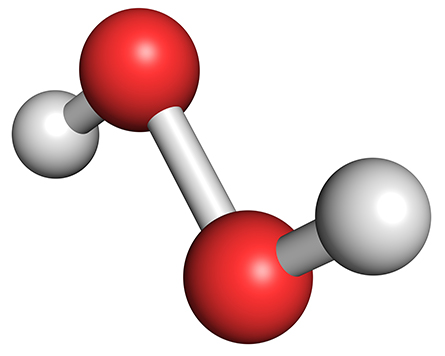
In its pure form Hydrogen Peroxide is a very pale blue liquid, slightly more viscous than water. It is used as an oxidizer, bleaching agent, and antiseptic. Concentrated hydrogen peroxide, or “high-test peroxide”, is a reactive oxygen species and has been used as a propellant in rocketry.
Hydrogen Peroxide can be corrosive to the eyes, skin, and respiratory system. This chemical can cause burns to the skin and tissue damage to the eyes.
Take special caution to avoid contact with hydrogen peroxide mist. Household-grade concentrations of this chemical are generally considered safe to use, but should never be ingested. Due to these potential hazards, hydrogen peroxide should be handled with care.
Hydrogen peroxide is most commonly available as a solution in water. For consumers, it is usually available from pharmacies at 3 and 6 % by weight concentrations. The concentrations are sometimes described in terms of the volume of oxygen gas generated; one millilitre of a 20-volume solution generates twenty millilitres of oxygen gas when completely decomposed. For laboratory use, 30 wt% solutions are most common. Commercial grades from 70% to 98% are also available, but due to the potential of solutions of more than 68% hydrogen peroxide to be converted entirely to steam and oxygen (with the temperature of the steam increasing as the concentration increases above 68%) these grades are potentially far more hazardous and require special care in dedicated storage areas.
Related Products
TOC-750 Addressable PID VOC Detector
TOC-750X Photoionisation Detector
TOC-750 Fixed SF6 Gas Detector – Addressable Detector
TOC-625-NHS – Oxygen Enrichment Monitor
TOC-30 Analogue Gas Detector
TOC-20 Refrigerant Gas Detector
Common Applications
Industrial Refrigeration
Farming & Agriculture
Food Processing
Green Energy
Typical Applications for the Use of H2O2:
About 60% of the world’s production of hydrogen peroxide is used for pulp- and paper-bleaching.
The second major industrial application is as an additive to detergents
It is also used in the production of various organic peroxides with dibenzoyl peroxide being a high volume example. It is used in polymerisations, as a flour bleaching agent, and as a treatment for acne. Peroxy acids, such as peracetic acid and meta-chloroperoxybenzoic acid also are produced using hydrogen peroxide. Hydrogen peroxide has been used for creating organic peroxide-based explosives, such as acetone peroxide.
H2O2 solution of 3% in water is used for contact lens soaking. The case includes a catalytic disc which neutralises the hydrogen peroxide over time.
Hydrogen peroxide is used in certain waste-water treatment processes to remove organic impurities. Hydrogen Peroxide can also oxidise sulphur based compounds present in the waste, beneficially reducing odour.
Sterilisation of various surfaces including surgical tools utilise H2O2 and it may be deployed as a vapour (VHP) for room sterilization. H2O2 demonstrates broad-spectrum efficacy against viruses, bacteria, yeasts, and bacterial spores.
Hydrogen peroxide is seen as an environmentally safe alternative to chlorine-based bleaches, as it degrades to form oxygen and water and it is generally recognized as safe as an antimicrobial agent by the U.S. Food and Drug Administration (FDA).
A less common application can be the treatment of acne on the skin. However benzoyl peroxide is a more common treatment for this rather than hydrogen peroxide.
Some horticulturalists and users of hydroponics advocate the use of weak hydrogen peroxide solution in watering solutions. Its spontaneous decomposition releases oxygen that enhances a plant’s root development and helps to treat root rot (cellular root death due to lack of oxygen) and a variety of other pests.
Finally there are some niche uses which include Chemiluminescence of cyalume, as found in a glow stick. Hydrogen peroxide has various domestic uses, primarily as a cleaning and disinfecting agent and as a hair bleaching agent. Hydrogen peroxide is also used for tooth whitening. It may be found in most whitening toothpastes. Hydrogen Peroxide can also be used to remove blood stains. This is because it reacts with blood as a bleaching agent, and so if a blood stain is fresh, or not too old, liberal application of hydrogen peroxide, if necessary in more than single application, will bleach the stain fully out. After about two minutes of the application, the blood should be firmly blotted out.
Related Products
TOC-750 Addressable PID VOC Detector
TOC-750X Photoionisation Detector
TOC-750 Fixed SF6 Gas Detector – Addressable Detector
TOC-625-NHS – Oxygen Enrichment Monitor
TOC-30 Analogue Gas Detector
TOC-20 Refrigerant Gas Detector
Common Applications
Industrial Refrigeration
Farming & Agriculture
Food Processing
Green Energy
H2O2 Gas Detector Solutions:
With the toxic effects of hydrogen peroxide and wide variety of uses, it is important users have hydrogen peroxide gas detector onsite. As mentioned above IGD can provide a variety of H2O2 gas detector solutions to protect staff and visitors from the deadly effects of H2O2.
Fixed hydrogen peroxide gas detector:
Our TOC-750S Aspirated gas detector is ideal for cleanrooms or where hydrogen peroxide use is a common occurrence. With the ability to sample from up to 20M away you can easily sample from outside of the environment. Thus reducing the surface area and negating any bug/dirt traps. In addition with the TOC-750S aspirated hydrogen peroxide gas detector unique “sensor protect” function, this means when fumigation is happening, the detector will not be overexposed to hydrogen peroxide. Thus ensuring not only a stable and accurate reading but the added benefit of extended lifetimes.
Send Us A Message
We are deeply committed to delivering unparalleled service and unwavering support to ensure your experience exceeds expectations.