Home / Applications / Laboratory Gas Detection
Scale up Your Lab Safety with Sentinel+
Toxic, flammable, and asphyxiant gases are among the most common and serious hazards found in lab environments. The best way to protect the vital work carried out in these critical workplaces is with a gas detection system that is tailored to the specific needs of your lab.
IGD provide scalable solutions for labs of any size or type, from single-room educational suites to huge multilevel research facilities. Our Sentinel+ range of fixed gas detection products offers unparalleled reliability, ultimate safety and a laboratory gas detection system that adheres to all regulatory compliance.


Continue reading for additional insights, or alternatively, click the button below to access our full online downloadable, e-book datasheet which is packed with valuable information and key specifications.
What are the Hazards?
No two lab environments are alike—differences in size, purpose and configuration often exist within the same facility. Each lab may present a unique set of gas hazards depending entirely on the processes and materials in use. That’s why it’s important to choose gas detection equipment that’s tailored to the specific risks in your lab. There’s no such thing as a “one-size-fits-all” solution. That’s why we’ve developed a range of sensors capable of detecting more than 700 gases and vapours. Our sensor technologies offer increased operational lifetimes and industry-leading detection ranges, enabling us to design custom gas detection solutions for even the most complex laboratory environments.
No matter how diverse your gas hazards may be, we can help you safeguard your people, processes, and property with precision—with one adaptable system for any lab.

Swift. Simple. Safe.
Sentinel+ is IGD’s exclusive gas detection system. The concept is simple: power and communications are both handled by a single polarity-independent 2-wire cable, utilising the only communications protocol specifically designed and optimised for gas detection. Everyone else uses at least 4 wires to run their systems. By doing a better job with just 2, we can offer ultimate protection for a fraction of the cost. The future of gas detection is digital.
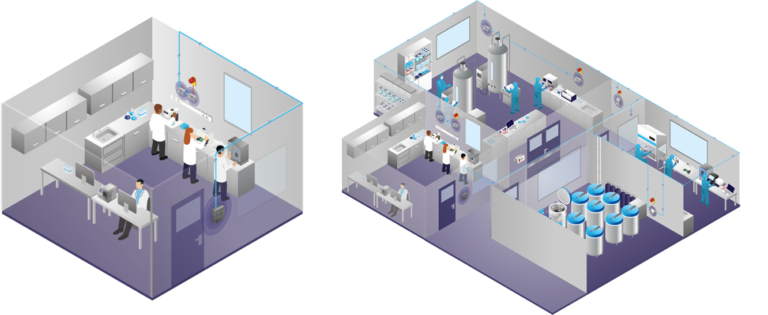
Sentinel+ is built to scale with your lab. Smaller labs may only need a TOC-635 Control Panel and a single TOC-750 Safe Area detector for each gas. Clean rooms and cryogenic suites can benefit from the TOC-750 Sampler and its range of end-of-line units. Larger facilities can be managed with a single TOC-750 Control Panel, linking up to 350 external devices across 1km and meeting a wide range of needs from one central hub. RSIs, Beacon Sounders, 7″ HMIs and GasNet remote monitoring combine to create the ideal solution for any laboratory. The adaptable nature of Sentinel+ means that even if labs are repurposed, our detectors can easily be adjusted to meet the new requirements.

Navigating Government Legislation
Implementing laboratory gas detection isn’t just best practice; it’s a legal obligation. Meeting regulations can be complex, but we can help you navigate them with industry expertise and a third-party accredited system that covers every requirement. The diverse gas risks presented by lab environments make understanding your legal obligations even more important.
In the UK, the Health and Safety at Work Act 1974 serves as the primary legislation governing all workplaces. Under this act, various supporting documents outline requirements for monitoring hazardous gases.
- The Control of Substances Hazardous to Health Regulations (COSHH) require employers to assess risks from hazardous substances.
- The EH40 list sets limits for monitoring toxic gases.
- The Dangerous Substances and Explosive Atmospheres Regulations (DSEAR) require workplaces to assess and control fire and explosion risks from hazardous substances. This includes monitoring flammable gases and oxygen levels.
- Approved Codes of Practice and Guidance Notes from the HSE outline best practice.
- Every country has its own gas monitoring and exposure rules. In the UK, it’s DSEAR, while in the USA, the key authorities are OSHA and NIOSH.
IGD sets two alarm levels on our systems, both below the formal legislative limits. Sentinel+ warns you of leaks early, so you can act before conditions become hazardous, alerting you to a problem before it becomes a problem.
Related Products
TOC-750 Addressable PID VOC Detector
TOC-750X Photoionisation Detector
TOC-750 Fixed SF6 Gas Detector – Addressable Detector
TOC-625-NHS – Oxygen Enrichment Monitor
TOC-30 Analogue Gas Detector
TOC-20 Refrigerant Gas Detector
Hydrogen Gas Detection Technology
Hydrogen is an odourless, colourless, and tasteless gas. Industry, therefore, relies on hydrogen gas detectors to detect leaks. IGD has two technologies suitable for detecting hydrogen: pellistor sensors and electrochemical sensors.
Pellistor
Pellistor, or catalytic bead, sensors rely on the use of a catalyst that causes flammable gas within the sensor to ignite at a much lower temperature than usual. When combustion occurs, heat is produced in proportion to the amount of flammable gas present. The concentration of flammable gases can then be derived from this measurement and expressed as a percentage of the lower explosive limit (%LEL).
Pellistor sensors are typically used as a general “catch-all” technology for flammable gas detection. Pellistors respond to any flammable gas, measuring 0-100% LEL. Since a 4% concentration of hydrogen is explosive, this corresponds to 100% LEL. Most legislation (such as the UK Dangerous Substance Explosive Atmosphere Regulations (DSEAR)) requires an atmosphere to be maintained below 25% LEL. IGD pellistor gas detectors are the world’s most reliable, cost effective and robust of their kind in the market, making them ideal for hydrogen gas detection.
Electrochemical
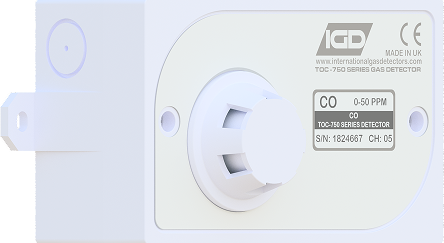
Electrochemical sensors work by reacting the target gas – in this case, hydrogen – with an electrolyte, which produces a current in proportion to the amount of gas present. This allows for much more sensitive hydrogen gas detection compared to pellistor sensors. For example, 25% LEL equates to 1% hydrogen concentration, or 10,000 ppm. IGD electrochemical gas detectors offer sensitivity in the ranges of 0-1000 ppm to 0-40,000ppm. However, the downside of this extreme sensitivity is that electrochemical sensors can be destroyed on exposure to levels exceeding their measurement range, requiring them to be replaced. IGD electrochemical hydrogen detectors are ideally suited to applications where detection of hydrogen at low levels is critical.
Other Detection Technologies
Several other gas detection technologies exist; however, these are not recommended for hydrogen detection.

Infrared sensors are unable to detect hydrogen since diatomic molecules like hydrogen don’t absorb infrared radiation.

Thermal conductivity is another viable technology, though low sensitivity and selectivity render them poor for hydrogen detection applications.

Semiconductor gas detectors can be used to detect hydrogen; however, these sensors also typically respond to a wide range of other gases and vapours. The likelihood of false alarms means that semiconductor sensors are not advised for these applications.
Related Products
Why You Need A Gas Detection Control Panel